


 Overland Park
Blog
September 16, 2026
Sports Braces Explained: Knee, Ankle, Shoulder & Elbow | TruMove
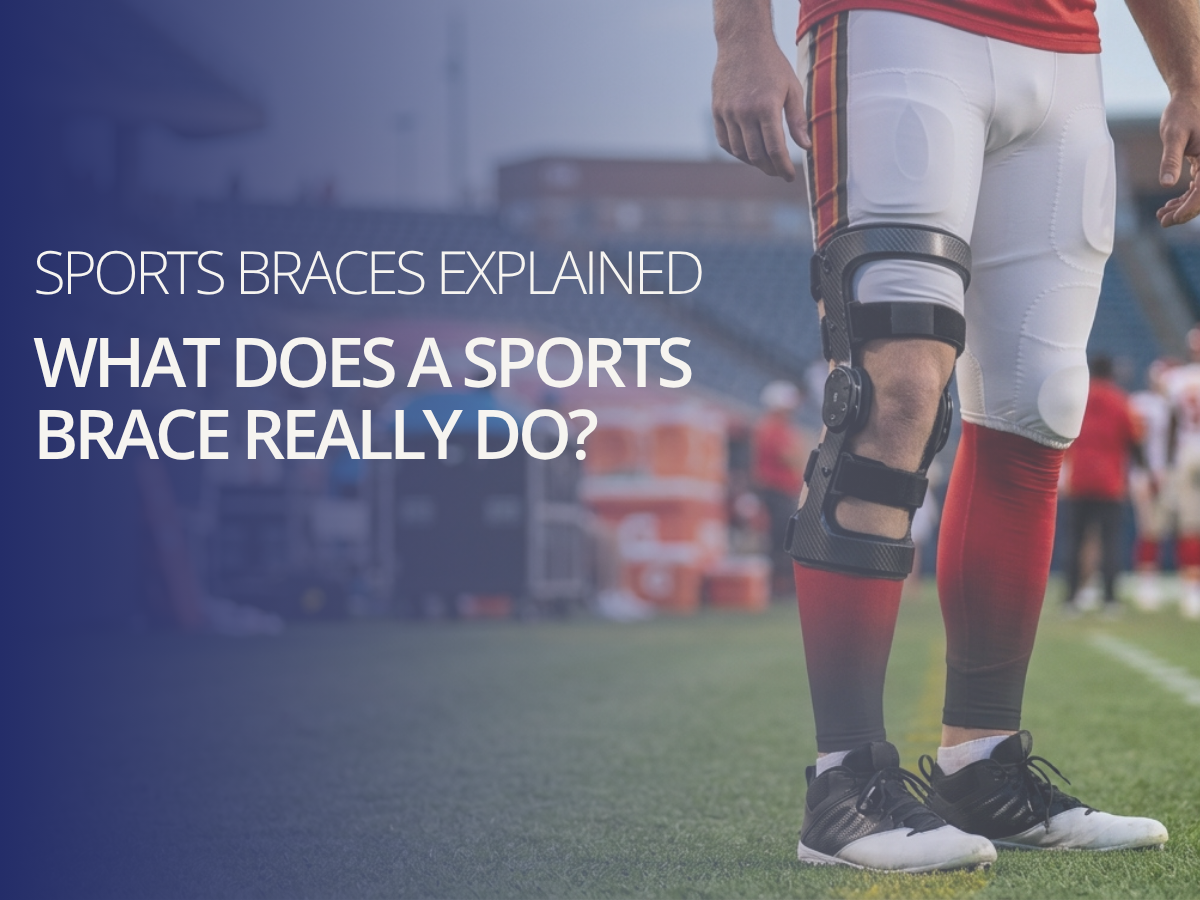
Patrick Mahomes returned to the field wearing something Chiefs fans are not used to seeing on him during an NFL game: a protective knee brace.
The brace was not there because his knee was simply “bad.” Mahomes was returning after a major knee injury and surgery involving the ACL and LCL, two ligaments that help stabilize the knee.
His return put sports and orthopedic braces back into the conversation.
At TruMove Physical Therapy in Overland Park, we hear a version of the same question from athletes, active adults, and people recovering from injuries:
What does a knee, ankle, shoulder, or elbow brace actually do?
The answer is more complicated than “braces are good” or “braces make you weak.”
A sports brace can be very useful. But it is not a replacement for strength, mobility, balance, healing, movement control, or rehabilitation.
The value of a brace depends on what you are trying to protect, what motion you are trying to control, how long you need it, and what you are doing while you wear it.
TL;DR: What You Should Know About Sports and Injury Braces
Sports and orthopedic braces can help protect a joint, limit painful or risky motion, redistribute force, improve confidence, or provide support during recovery.
They do not replace strength, mobility, balance, healing, or rehabilitation.
Some braces are useful for short term protection after an injury or surgery. Others, such as ankle braces or tennis elbow straps, may reduce symptoms or lower reinjury risk in certain situations.
The important question is not simply whether a brace is good or bad. It is what job the brace is supposed to do, and whether your body is becoming more capable while you use it.
Most over the counter sports braces do not require a doctor’s prescription. Custom, post surgical, or specialized orthopedic braces may require medical guidance or documentation, especially if insurance is paying for them.
What Does a Sports Brace Actually Do?
Depending on the type of brace, it may help by doing one or more of the following:
What a brace cannot do is rebuild muscle, restore balance, retrain movement, heal a tendon by itself, or guarantee that another injury will not happen.
A brace can create a margin of safety. It cannot do the rehab for you.
Why Is Patrick Mahomes Wearing a Knee Brace?
Mahomes injured the ACL and LCL in his left knee late in the 2025 season and underwent surgery. His return required months of rehabilitation before he was cleared to fully participate again.
For an athlete coming back from a major ligament injury, a hinged knee brace may be used to limit certain stresses, provide external stability, and add confidence during cutting, scrambling, contact, and other unpredictable movements.
That does not mean the brace is holding the knee together.
By the time an athlete is cleared to play an NFL game, the expectation is that the repaired tissue, surrounding muscles, nervous system, and movement control have progressed enough to tolerate football.
The brace is another layer of protection.
It is not the foundation of the recovery.
Ethan McCoy, DPT, on Sports Braces
“I think braces are a great thing for this very reason. They’re a support tool, even if it’s just there to make the athlete feel better. There’s only so much that brace is going to do support wise, but it is something.”
McCoy pointed out that Mahomes had an advantage many people do not have when they first put on a brace: he had been practicing and training in it throughout the offseason.
That matters.
A brace can feel awkward when an athlete is not accustomed to it, particularly during cutting and rapid changes of direction. Mahomes’ brace was custom made and reportedly very light, which McCoy felt helped minimize its effect on his movement.
McCoy also described the basic idea behind a ligament style knee brace this way: it is essentially providing additional external support around the knee, somewhat like adding another layer of ligament support.
A brace may help limit excessive side to side movement or twisting, but it cannot eliminate those movements completely. An athlete still needs some of that motion to run, cut, and perform.
And there are limits to what any brace can protect against.
As McCoy put it during the podcast, an NFL player is still getting hit by 300 pound athletes. A lightweight brace can provide support, but it cannot make the knee invulnerable.
The Important Distinction
The brace supports the athlete. It does not replace the athlete’s repaired ligament, strength, movement control, or rehabilitation.
The question is rarely just, “Should I wear a brace?”
A better question is:
What are we asking the brace to do?
What Are the Main Types of Sports and Orthopedic Braces?
“Brace” is a broad term.
A soft compression knee sleeve and a rigid hinged knee brace may both go around the same joint, but they are not doing the same job.
Protective or Functional Braces
These braces are designed to limit certain motions or add external support while still allowing activity.
Hinged knee braces and some shoulder instability braces fall into this category.
They are commonly used when someone needs support but still needs to move, practice, compete, or perform everyday activities.
Rehabilitative or Post Surgical Braces
These braces are commonly used after surgery or a significant injury.
Some can be locked at specific angles or gradually adjusted as healing progresses.
A surgeon may prescribe very specific instructions for when the brace can come off, how much motion is allowed, and whether weight bearing is permitted.
In these situations, the brace is part of a medical recovery plan rather than simply a piece of sports equipment.
Unloader Knee Braces
Unloader braces are most commonly used around the knee.
They are designed to shift force away from a painful part of a joint, such as one side of an arthritic knee.
The goal is not necessarily to make the knee more stable.
The goal is to change where the load goes.
Counterforce Elbow Braces
The classic example is the strap worn below the elbow for lateral elbow tendinopathy, commonly called tennis elbow.
The goal is to change how force travels through the irritated tendon during gripping and lifting.
These are common among tennis players, pickleball players, golfers, tradespeople, and anyone performing repetitive gripping activities.
Compression Sleeves
Compression sleeves provide much less mechanical restraint.
Their benefit may come more from compression, warmth, sensory feedback, swelling control, and the feeling of support.
That does not mean the benefit is imaginary.
Feeling more secure can affect how comfortably and confidently someone moves.
Do Knee Braces Work?
Sometimes.
But “knee brace” covers several completely different situations.
A knee brace after an MCL injury is being asked to do something different from a brace used following ACL reconstruction.
An arthritis unloader brace is doing something different from both.
For people recovering from ACL reconstruction, research has not shown a clear long term advantage to routinely bracing every patient after surgery compared with rehabilitation without routine bracing.
Measures such as strength, range of motion, knee stability, pain, and function are often similar between braced and nonbraced groups.
That does not mean nobody should wear a knee brace after ACL surgery.
A surgeon may recommend one because of the specific injury, additional ligament damage, the surgical procedure, healing stage, sport, or other individual factors.
It does mean the brace should not be mistaken for the thing that makes the reconstructed knee strong again.
That job belongs to rehabilitation.
Can a Knee Brace Prevent an Injury?
This is where the research becomes less clear.
Preventive knee braces have been studied in football players for decades, particularly for protecting the medial collateral ligament from contact.
Some studies have found fewer injuries in braced athletes. Others have not found a meaningful difference.
That makes it difficult to justify putting every healthy athlete into a rigid knee brace simply as a precaution.
A brace makes more sense when there is a specific reason for using it.
That could include a previous ligament injury, a period of return to sport, a recommendation from a surgeon or physical therapist, or a position that creates unusual contact demands.
Can Wearing a Sports Brace Make Your Muscles Weaker?
This is one of the biggest concerns people have about braces.
The idea makes sense at first.
If the brace is supporting the joint, maybe the muscles stop doing their job.
Short term brace use does not automatically make a joint or muscle weak.
The bigger concern is what happens when someone uses a restrictive brace for a long period, avoids normal movement, and never rebuilds strength, balance, or control.
The problem may not be the brace itself.
The problem is allowing the brace to become the entire treatment plan.
For example, someone may wear a knee brace every time they squat, walk, golf, run, or climb stairs because they no longer trust the knee without it.
At that point, we would want to know why.
Those are different problems, and they need different solutions.
What About Elbow Braces and Tennis Elbow Straps?
An elbow strap is a good example of a sports brace that may help without actually healing the underlying problem.
A counterforce strap is usually positioned on the upper forearm below the painful area of the elbow.
Its purpose is to change how force is transmitted through the forearm muscles and tendon during gripping, lifting, tennis, pickleball, yardwork, or repetitive hand use.
Research suggests these braces may reduce pain in the short term for some people with lateral elbow tendinopathy.
That can still be useful.
If a strap lets someone work, exercise, play pickleball, or perform rehabilitation with less pain, it may help that person stay active.
But the strap does not restore tendon capacity.
It does not correct grip strength, shoulder mechanics, workload, technique, or how much force the tendon can tolerate.
Those are rehabilitation questions.
What About Shoulder Braces?
Shoulder braces are a different situation because the shoulder depends on a large amount of motion.
A brace for shoulder instability may limit the arm from moving into positions associated with dislocation or apprehension.
For a football player, wrestler, or contact athlete, that can provide additional protection or confidence while returning to competition.
There is also an obvious tradeoff.
The more motion the brace restricts, the more it may interfere with athletic performance.
That matters much more to a quarterback, pitcher, swimmer, or volleyball player than it does to an athlete whose position does not require repeated overhead movement.
Research on shoulder bracing for instability is mixed.
Some athletes report improved confidence and symptom relief, but studies have not consistently shown that bracing prevents another instability episode.
This is a good example of why the brace needs to match both the injury and the activity.
Are Ankle Braces Different?
Ankle braces have some of the stronger evidence for reducing recurrent injuries, particularly in athletes who have already sprained an ankle.
That makes sense clinically.
One of the biggest risk factors for another ankle sprain is having had an ankle sprain before.
A sports ankle brace may help reduce that risk.
But even here, the brace is not the whole answer.
Balance training, strength, hopping, landing, cutting, and other neuromuscular exercises still matter.
The brace can reduce risk while the athlete continues rebuilding the physical qualities that make the ankle more resilient.
Why Do Some People Feel So Much Better in a Brace?
Not every benefit from a sports brace is purely mechanical.
Your nervous system is constantly collecting information about joint position, pressure, movement, speed, and force.
A brace adds more sensory information around the joint.
For some people, that changes how stable or controlled the joint feels.
Confidence matters too.
After an ACL tear, ankle sprain, or shoulder dislocation, the first hard cut, jump, hit, or overhead reach can feel very different even after the tissue has healed.
A brace may help an athlete trust the movement enough to perform it normally again.
That psychological benefit should not automatically be dismissed.
At the same time, confidence from a brace should eventually be supported by actual physical capacity.
Why Do Some People Think Sports Braces Are Bad?
The concern is usually not that braces themselves are inherently bad.
The concern is overreliance.
Someone may begin wearing a brace because of a legitimate injury and continue wearing it months or years later simply because movement feels unfamiliar without it.
There can also be a temptation to use a brace as permission to ignore pain.
“I have the brace on, so I am protected.” That is not always how it works.
A brace cannot make every activity safe.
It cannot override tissue healing.
It cannot compensate for every strength deficit.
And it cannot guarantee that another injury will not happen.
The brace should support the recovery process, not replace it.
What Are the Downsides of Wearing a Sports Brace?
Sports and orthopedic braces are not automatically harmless just because many are available over the counter.
Potential problems can include:
A brace that helps one person may be completely unnecessary for someone else with pain in the same body part.
A Sports Brace Should Have a Job
This may be the simplest way to think about bracing.
Before using a brace, we should be able to explain what we want it to accomplish.
Questions we often consider include:
If those questions do not have good answers, buying a more expensive brace may not solve the problem.
The Bigger Question: What Are You Trying to Protect?
A 17 year old offensive lineman returning from an MCL sprain has a very different need from a 52 year old pickleball player with elbow pain.
A runner with a history of ankle sprains has a different problem from someone with knee arthritis.
Patrick Mahomes scrambling away from an NFL defensive lineman has different demands from someone returning to recreational golf after knee surgery.
The word “brace” may be the same.
The reason for using one is not.
That is why there is no single rule that says sports braces are good or bad.
How Does Physical Therapy Fit With Sports Braces?
At TruMove Physical Therapy in Overland Park, we do not look at a brace as automatically good or bad.
We look at whether it helps a specific person do something safely and productively.
A physical therapy evaluation may include:
Sometimes the right answer is to use the brace.
Sometimes the right answer is to use it only during higher risk activities.
Sometimes the right answer is to gradually stop using it.
And sometimes the brace is treating the feeling of instability while the actual movement problem is somewhere else.
That is why the evaluation matters.
Learn more about physical therapy in Overland Park at TruMove.
The Real Deal on Sports Braces
Patrick Mahomes wearing a knee brace is not evidence that everyone recovering from an ACL injury needs one.
It is a good example of what a sports brace is supposed to be:
One tool inside a much larger recovery plan.
A brace can protect. It can unload. It can limit motion. It can reduce symptoms. It can improve confidence.
But it cannot replace healing, strength, mobility, balance, or good movement.
The best brace is not necessarily the most rigid or most expensive one.
It is the brace that has a clear job, fits the person and the activity, and supports the work being done to make the body more capable without it.
If you are wearing a knee, ankle, elbow, or shoulder brace and are not sure whether you still need it, a physical therapist can help determine what the brace is doing, what your body can handle without it, and what should come next.
Not Sure Whether You Still Need the Brace?
A TruMove physical therapist can evaluate the joint, your strength, movement, stability, and the activity you are trying to return to.
Frequently Asked Questions About Sports and Injury Braces
Does Wearing a Brace Weaken the Joint?
Not automatically.
Short term brace use does not necessarily reduce muscle strength. Problems are more likely when a restrictive brace replaces normal movement, strengthening, and rehabilitation for a long period.
A good rehabilitation plan should build the strength and control needed to function with less external support when appropriate.
Should Everyone Wear a Knee Brace After ACL Surgery?
No.
Research does not show a clear benefit from routine postoperative bracing for every ACL reconstruction.
A surgeon may still prescribe a brace based on the specific injury, surgery, additional ligament damage, healing stage, or activity demands.
The brace should match the individual situation.
Do I Need a Doctor’s Note to Wear a Sports Brace?
Most over the counter knee sleeves, ankle braces, tennis elbow straps, wrist braces, and similar sports supports do not require a doctor’s prescription.
A prescription or medical documentation may be needed for a custom orthopedic brace, a brace used after surgery or a significant ligament injury, or when insurance is expected to pay for it.
Even when a prescription is not required, a physical therapist or physician can help determine whether the brace is appropriate, how it should fit, when to wear it, and whether you still need it as recovery progresses.
Can a Knee Brace Prevent an ACL Tear?
A knee brace cannot guarantee prevention of an ACL injury.
Preventive knee bracing in football has produced mixed research results.
Strength, neuromuscular control, landing mechanics, sport demands, fatigue, and exposure all matter.
How Tight Should a Sports Brace Be?
A brace should generally be snug enough to stay in the correct position and perform its intended job without causing numbness, tingling, skin color changes, increased swelling, skin irritation, or worsening pain.
A brace that constantly slides, pinches, or causes new symptoms may not fit correctly.
Can I Wear a Brace All Day?
That depends on the brace and why you are wearing it.
A post surgical brace may have a very specific wear schedule from a surgeon. A sports brace may only be necessary during activity. An elbow strap may only be useful during certain tasks.
Wearing a brace for more hours does not automatically make it more effective.
Does a Tennis Elbow Strap Heal Tennis Elbow?
No.
A counterforce strap may reduce pain during gripping and activity, but it does not rebuild the tendon’s capacity to handle force.
Progressive exercise, appropriate loading, and workload management are usually important parts of longer term recovery.
Can a Shoulder Brace Prevent Another Dislocation?
A shoulder brace can limit positions that may place the shoulder at greater risk and may improve confidence.
Research has not consistently shown that functional bracing prevents recurrent instability.
The decision depends heavily on the athlete, the sport, the type of instability, and the stage of recovery.
Are Ankle Braces Worth Wearing After a Sprain?
They can be.
Ankle bracing has evidence supporting its use for reducing recurrent sprains, particularly in people with a previous ankle injury.
Balance, strength, and neuromuscular training should still be part of the recovery plan.
When Should I Stop Wearing a Sports Brace?
The answer should be based on why you started wearing it.
Factors may include:
The goal is not to remove a brace as quickly as possible.
The goal is to stop needing it when it is safe and appropriate to do so.
Sources
Bracing after ACL reconstruction: systematic review
Strength and bracing after ACL reconstruction
Prophylactic knee bracing in football
Counterforce bracing for lateral elbow tendinopathy
Functional bracing for shoulder instability
The information in this article is for educational purposes and is not a substitute for an individual medical evaluation. Brace recommendations vary based on diagnosis, injury severity, surgery, healing stage, sport, and other factors. Follow the instructions of your surgeon, physician, or physical therapist when a brace has been prescribed as part of your care.


