


 Overland Park
Blog
April 24, 2026
Unlocking Golf Swing Rotation: How to Protect Your Spine
If you’ve ever tried to “turn harder” to get more distance and ended up with a stiff lower back by the back nine, you’re not alone. It’s one of the most common patterns we see — golfers chasing distance the hard way, through effort instead of movement efficiency.
The frustrating part: working harder often makes things worse. The lower back gets more load, the swing gets tighter, and eventually something gives out. The good news is that rotation limitations are very fixable — once you understand where the problem actually lives.
Your Body Doesn’t Rotate as One Unit
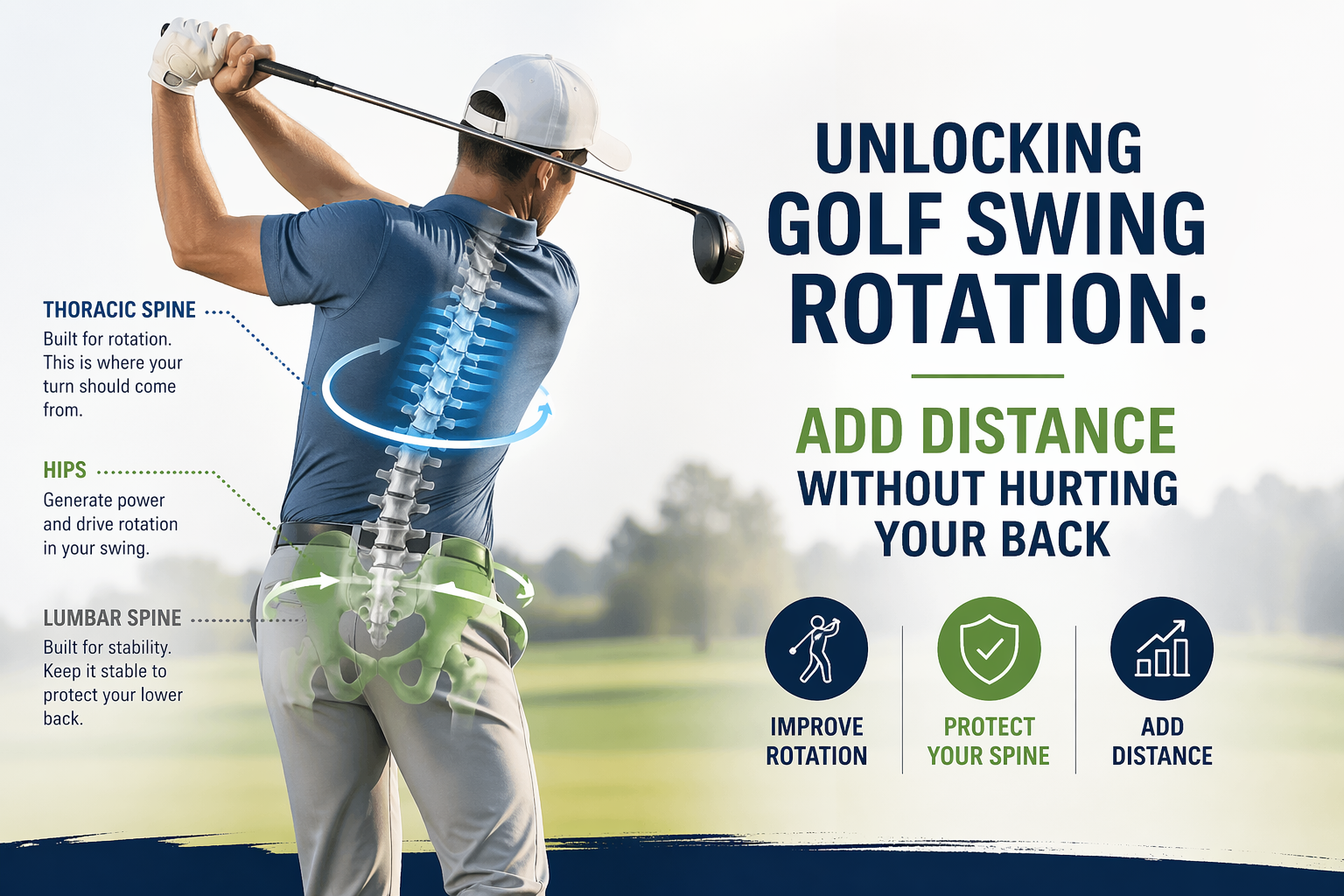
This is the most important thing to understand about the golf swing from a movement standpoint. Each section of the spine has a different job, and when you treat them like one structure, you run into problems.
- Thoracic spine (mid-back): This is where the majority of your rotational range should come from. It’s built for it.
- Hips: The engine. They generate the rotational force that gets transferred up the chain and into the club.
When the thoracic spine or hips are stiff, the body doesn’t just stop rotating — it borrows range from wherever it can find it. That usually means the lower back. Over time, that compensation pattern becomes the default, and the lower back pays for it.
Three Mobility Restrictions That Quietly Wreck Your Swing
In our golf performance screens, we test movement patterns specific to what the swing actually demands. These three restrictions show up more than anything else:
1. Trail Shoulder Mobility
Your trail shoulder (right shoulder for right-handed golfers) needs enough external rotation to allow a full backswing without forcing the spine to compensate. When that range is limited — which is common in people who work at a desk — the swing gets short and the body makes up the difference by over-rotating the lower back or lifting through impact.
2. Thoracic Spine Stiffness
A rounded upper back is almost universal in people who sit for most of the workday. That rounded position compresses the thoracic segments and reduces how much rotation is available. If your mid-back can’t rotate freely, there’s simply less total turn to work with — and the lower back gets recruited to compensate.
3. Lead Hip Internal Rotation
This one is underappreciated. Your lead hip (left hip for right-handed golfers) needs to internally rotate during the downswing and follow-through to allow the pelvis to clear properly. When that’s restricted, the pelvis stalls, the lower back and SI joint absorb the rotational stress, and power leaks out of the swing. It’s also one of the most common contributors to lower back pain that worsens through a round.
Three Drills to Restore Rotation Safely
The goal with each of these is to build range of motion in the right places — not to stretch aggressively, but to teach the body where it’s allowed to move.
Drill 1: Wall Angels
Stand with your back against a wall, feet a few inches out, knees slightly bent. Press your lower back, upper back, and head into the wall. Start with your arms bent at 90° (“goalpost” position) and slowly slide them overhead, keeping contact with the wall the entire time. Return slowly. Do 10 reps.
What it does: Improves thoracic extension and shoulder blade mobility — two things that directly affect how much rotation you can access at the top of your backswing.
Drill 2: Golf Club External Rotation Stretch
Hold a golf club horizontally behind your back at waist height with both hands, palms facing away. Gently draw the club upward toward your shoulder blades while keeping your chest tall. Hold for 5–10 seconds and release. Repeat 8–10 times.
What it does: Opens up external rotation in the trail shoulder, allowing a fuller backswing without the spine having to compensate for restricted shoulder range.
Drill 3: Thoracic Wall Rotations
Sit sideways next to a wall with your knees bent and feet flat on the floor. Place both hands on your knees. Rotate your upper body toward the wall, reaching both arms out to place your hands flat against it. Hold briefly, return, and repeat. Do 8–10 reps per side.
What it does: Trains the separation between your upper and lower body — the “hip-to-shoulder” differential that generates power in a golf swing. It also directly targets thoracic rotation mobility in a controlled position.
What Changes When Rotation Comes from the Right Places
When these restrictions get addressed, the swing changes in ways that feel almost mechanical. Golfers typically notice:
- A fuller, more comfortable backswing without consciously trying to “turn more”
- Better hip clearance and follow-through
- Improved club head speed without adding effort
- Less lower back tightness during and after a round
- More consistent ball striking, because the swing path becomes more repeatable
The bigger picture: better movement patterns mean you can play more frequently without needing a recovery day afterward. For golfers who are serious about staying in the game long-term, that’s what actually matters.
When to Get a Professional Movement Screen
These drills address the most common patterns, but they won’t catch everything. If you’ve been dealing with persistent back tightness, you’ve noticed your swing getting shorter over the years, or you just want to know exactly where your movement is breaking down — a golf performance screen gives you specifics instead of guesses.
At TruMove Physical Therapy, we use a golf-specific movement screen to assess where your rotation is actually coming from, where it’s being limited, and what’s creating compensation. From there, we build a plan around what your body needs — not a generic protocol.
Whether the goal is more distance, less pain, or just not grinding through 18 holes — the starting point is understanding how your body moves.
Book a Golf Performance Screen →
Frequently Asked Questions
Why does my lower back hurt during my golf swing?
Lower back pain during a golf swing usually means the lumbar spine is being asked to rotate more than it’s built for. The lower back allows only about 5–15° of rotation — it’s a stability structure, not a rotation driver. When the thoracic spine or hips are stiff, the lower back compensates, leading to cumulative irritation over time.
How do I add distance without hurting my back?
By improving mobility in the areas designed for rotation — the thoracic spine and hips — rather than forcing more effort from the lumbar spine. Better rotation mechanics translate directly to club head speed, without loading structures that aren’t built to handle it.
What is a golf performance screen?
A movement assessment where a physical therapist evaluates the mobility, stability, and rotation patterns specific to the golf swing. It identifies where your body is restricted, why compensation is happening, and what needs to change — so the plan is built around your body and your swing.
Can physical therapy actually improve my golf swing?
Yes, when the issue is movement-based. Physical therapy addresses the underlying restrictions — thoracic stiffness, hip mobility deficits, shoulder range of motion — that affect swing mechanics. Improving those directly impacts club head speed, consistency, and how your body holds up over a full season.


