


 Overland Park
Blog
May 12, 2026
Pickleball Injury Prevention in Overland Park: The Longevity Blueprint
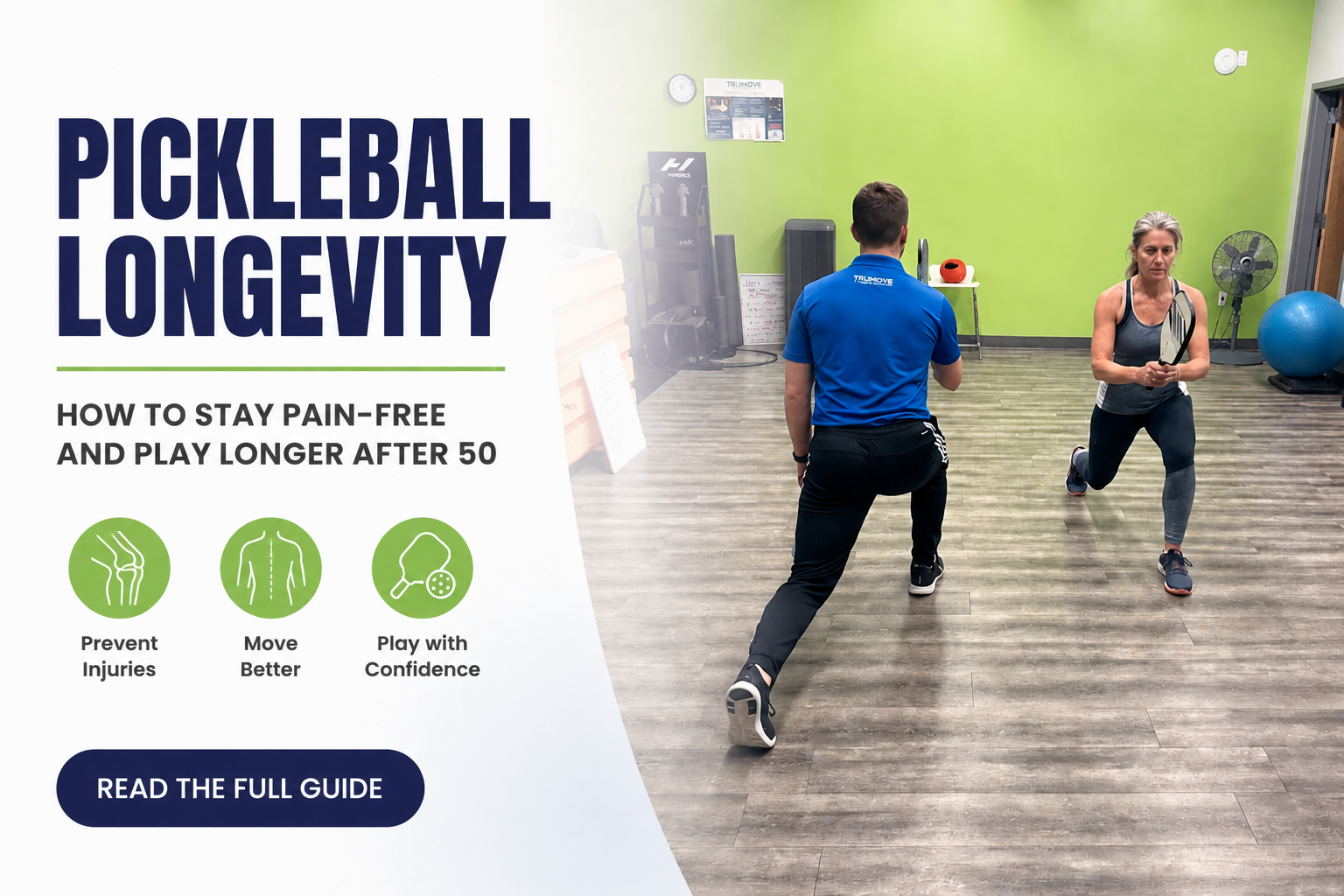
The Overland Park Pickleball Longevity Blueprint: How to Keep Playing Pain-Free After 50
Pickleball has completely changed the recreational sports landscape in Overland Park.
Courts are packed at local community centers, Life Time, neighborhood parks, and indoor facilities across Johnson County. What started as a casual social activity has become one of the fastest-growing sports in America, especially among active adults looking for competition, movement, and community.
But there’s another trend happening alongside pickleball’s explosive growth: injuries.
At TruMove Physical Therapy in Overland Park, we’ve noticed a major increase in pickleball-related shoulder, knee, Achilles, elbow, and balance-related issues over the last few years — especially among highly active adults trying to stay competitive while balancing work, travel, family, fitness, and inconsistent recovery.
One of the most common things we hear is: “I feel okay while I’m playing, but I can barely get moving the next morning.”
The good news: many pickleball injuries are not random. They often develop from movement inefficiencies, compensation patterns, and repetitive overload — which means they can often be addressed before they become time-loss injuries.
The key is understanding that pickleball performance and pickleball longevity are actually the same thing. Players who move efficiently tend to play longer, recover faster, and avoid the overuse patterns that commonly lead to setbacks.
Why Pickleball Injuries Are Increasing So Quickly
As participation has grown, orthopedic and sports medicine providers across the country have reported a sharp rise in pickleball-related injuries. These include lower extremity injuries, shoulder and elbow issues, Achilles problems, and fall-related wrist fractures.
Unlike tennis, pickleball places athletes in repeated short-burst movement patterns: sudden stops, rapid direction changes, lunges, reaches, and quick reactions in a confined space.
Those movements create significant stress on joints and tendons, especially when mobility, strength, balance, or coordination start declining with age.
The Big Misunderstanding
Most pickleball injuries are not caused by one bad movement. They often develop gradually from small movement faults that the body keeps repeating until one area finally gets overloaded.
The Physics of the Dink: Why Movement Efficiency Matters
One of the biggest misconceptions about pickleball is that it is “easy on the body.”
While the court is smaller than tennis, the sport actually demands rapid deceleration, balance control, rotational power, and fast reactions, especially near the kitchen line.
The body has to absorb and redirect force constantly.
At TruMove, we often explain pickleball injuries through something called the kinetic chain.
The kinetic chain simply means this:
The body works as a connected system.
If one area is stiff, weak, unstable, or poorly coordinated, another area has to compensate.
That compensation is what frequently leads to pain.
The Three Pillars of Pickleball Longevity
1. Lower Extremity Deceleration
Pickleball players spend a tremendous amount of time slowing their bodies down.
Every lunge, lateral cut, or quick stop requires the hips, glutes, calves, and quads to absorb force safely.
When those systems are not functioning efficiently, the stress shifts directly into passive structures like:
- Meniscus cartilage
- Ligaments
- Patellar tendons
- Achilles tendons
- Joint surfaces
This is why knee pain is one of the most common pickleball complaints.
Many players think the solution is simply wearing a brace or resting. Often, the bigger issue is poor deceleration mechanics, ankle mobility limitations, or weak glute control.
Many pickleball players think more stretching is the answer. In reality, many injuries come from poor force absorption and deceleration mechanics, not simply “tight muscles.”
2. The Core-to-Paddle Transfer
Many shoulder and elbow injuries in pickleball actually begin in the trunk and hips.
If the thoracic spine — the mid-back — cannot rotate efficiently, players compensate by generating power through the shoulder, elbow, or wrist instead.
That repetitive “over-swinging” pattern contributes to:
- Pickleball elbow
- Rotator cuff irritation
- Shoulder impingement
- Wrist tendon irritation
The paddle is simply the end point of a much larger movement system.
Improving thoracic rotation and hip mobility often reduces arm stress dramatically.
3. The Proprioceptive Shield
One of the most overlooked injury prevention tools is balance training.
As we age, the body’s ability to react to sudden instability can decline. This affects:
- Reaction time
- Foot placement
- Joint positioning
- Fall recovery ability
That matters because falls are one of the fastest-growing sources of pickleball injuries nationwide. Wrist fractures and FOOSH injuries, falling on an outstretched hand, have increased sharply as participation has exploded.
Balance and proprioception training help create what we call a “protective buffer” between the athlete and injury.
Why Pickleball Injuries Often Start Above or Below the Pain
This is one of the biggest advantages of working with a sports-focused physical therapist instead of simply resting or chasing symptoms.
Pain is often not the true source of the problem.
Examples we commonly see:
- Limited ankle mobility causing knee stress during lunges
- Hip stiffness forcing rotational stress into the lower back
- Poor scapular control contributing to shoulder irritation
- Thoracic stiffness leading to excessive wrist flicking
The body always finds a way to complete the movement, even if it means overloading another area.
A Better Question
Instead of asking “Where does it hurt?” we often ask: “Why is that area being overloaded in the first place?”
A Common Pattern We See at TruMove
A player starts feeling mild knee tightness after long matches. Then they begin avoiding deeper lunges. A few weeks later, the shoulder starts getting sore because they are compensating with upper-body reach instead of moving through the hips.
What started as “just stiffness” becomes multiple overloaded areas.
That is why our approach does not stop at the painful joint. At TruMove, we evaluate how the entire body transfers force through cutting, rotating, planting, reaching, and recovering.
We often find the painful area is simply the area absorbing stress — not the original problem.
The 50+ Athlete Is Different — But That’s Not a Bad Thing
Many active adults assume pain is just part of getting older.
That mindset causes people to delay treatment until injuries become much more difficult to manage.
The reality:
Aging changes tissue recovery, joint stiffness, muscle elasticity, and reaction time, but movement quality still matters tremendously.
Players over 50 often perform best when they focus on:
- Mobility maintenance
- Strength training
- Recovery management
- Movement efficiency
- Balance training
- Workload management
The goal is not just to eliminate pain.
The goal is longevity.
Our goal is not simply to “calm things down.” It is to help active adults continue doing the activities that give them energy, competition, and community.
Why This Matters in Overland Park
Overland Park has one of the most active adult recreational communities in the region. Many players are balancing work, fitness, golf, tennis, strength training, travel, grandkids, and pickleball all at once,which makes recovery and movement quality even more important.
We regularly work with players coming from local courts, community centers, and neighborhood games across Johnson County. The hard outdoor court surfaces common around Overland Park can be especially demanding on knees, calves, and Achilles tendons during long summer sessions.
The players most likely to get hurt are often the ones trying hardest to stay active.
That is why a proactive movement plan matters.
What a Pickleball Movement Assessment Looks Like
At TruMove Physical Therapy, our approach goes far beyond simply treating symptoms.
A pickleball-focused movement evaluation may include:
- Balance testing
- Single-leg stability analysis
- Hip mobility assessment
- Thoracic rotation screening
- Ankle mobility testing
- Strength and deceleration analysis
- Movement efficiency testing
The purpose is to identify the weak links before they become injuries that force time away from the court.
For many active adults, the evaluation itself becomes a roadmap for staying active longer.
In Kansas, you can see a physical therapist directly without waiting for a physician referral, which often allows athletes and active adults to address movement problems much earlier.
Simple Warning Signs You Shouldn’t Ignore
Many pickleball injuries start with small symptoms:
- Morning stiffness that lasts longer than usual
- Loss of confidence planting or cutting
- Elbow soreness after long sessions
- Shoulder tightness during overhead shots
- Knee discomfort after multiple matches
- Feeling unstable or “off balance” near the kitchen line
These are often early movement warnings, not just random soreness.
Addressing those issues early can reduce the likelihood of more serious injuries later.
The Overland Park Pickleball Longevity Blueprint
The players who stay healthiest long-term are usually not the ones who simply “push through.”
They are the players who:
- Move efficiently
- Recover intelligently
- Maintain mobility
- Train balance and stability
- Address issues early
- Understand how the body works as a system
That is the blueprint for continuing to play competitively, confidently, and pain-free.
Whether you are trying to avoid your first injury or keep a nagging issue from becoming a bigger setback, a movement-focused approach can help you stay on the court longer.
Frequently Asked Questions About Pickleball Injuries
What is the most common pickleball injury?
Knee injuries are among the most common, followed closely by shoulder pain, pickleball elbow, Achilles problems, and falls resulting in wrist injuries.
Can physical therapy help prevent pickleball injuries?
Yes. Physical therapy can help identify mobility restrictions, balance deficits, strength limitations, and inefficient movement patterns before they contribute to pain or injury.
Why do so many pickleball players develop elbow pain?
Many cases of pickleball elbow are related to poor kinetic chain mechanics, where the shoulder, trunk, or hips are not contributing efficiently to paddle movement.
Is pickleball safe after 50?
Yes. Many adults successfully play pickleball well into their 60s, 70s, and beyond. The key is maintaining movement quality, balance, strength, and recovery capacity.
Sources
- USA Pickleball: What Is Pickleball?
- Raleigh Orthopaedic Team: Pickleball Injuries and When to Seek Care
- Pickleball-Related Fractures in the United States From 2002 to 2022
- AAOS: Increased Fracture Risk for Older Pickleball Players
- Increasing Incidence of Pickleball Injuries Presenting to U.S. Emergency Departments


