


 Overland Park
Blog
February 5, 2026
Lindsey Vonn ACL Injury: 2026 Olympic Return & Overland Park PT
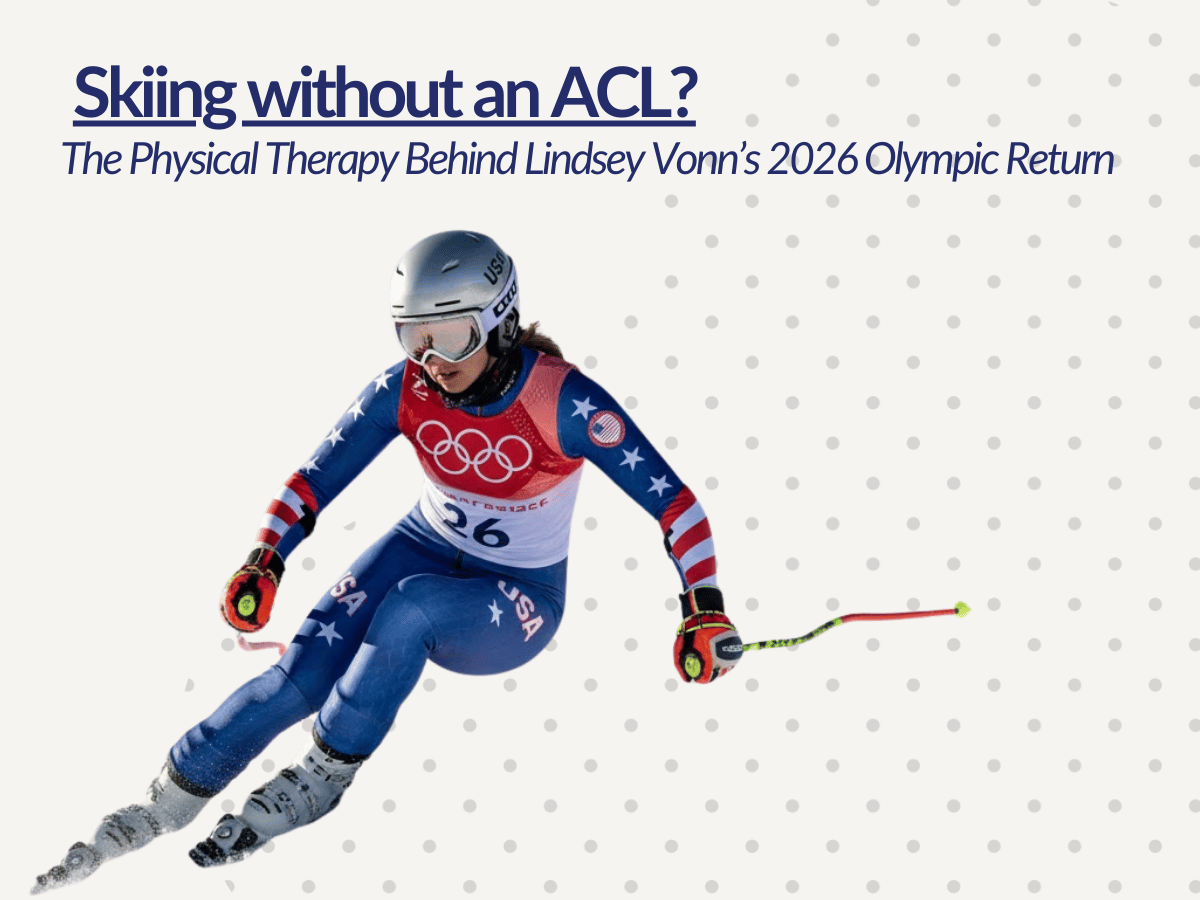
The sports world is buzzing after Lindsey Vonn confirmed a complete rupture of her left ACL following a crash in Crans-Montana. Despite the severity, the 41-year-old legend is pushing toward the 2026 Milano Cortina Winter Olympics. At our Overland Park physical therapy clinic, we’re seeing a surge of questions about whether it’s truly possible to compete at an elite level without a primary stabilizer like the ACL.
The Science of “Coping”: Why Strength Matters in Overland Park
In the PT world, Vonn is attempting to become a “coper.” This refers to individuals who use intensive neuromuscular training and secondary stabilizers—like the quads, hamstrings, and glutes—to maintain knee stability despite a missing ligament. This is a protocol we often discuss with high-level athletes here in Overland Park who are looking for non-surgical paths or advanced “pre-hab.”
In her latest rehab video, Vonn is shown performing heel-elevated front squats and box jumps. For a specialist in sports physical therapy, these movements are the gold standard for testing “functional stability.” If the knee can handle these loads, there is a path to the podium.
3 Keys to ACL Stability Without Surgery
- Neuromuscular Speed: Training the brain to fire the hamstrings instantly to protect the knee joint.
- Local Proprioception: Enhancing the “joint sense” that is often diminished after a tear.
- Custom Bracing: Vonn will rely on a custom-fitted brace for the Olympic Downhill on Feb 8th.
In a recent training video, Vonn is seen performing heel-elevated front squats, side lunges, and box jumps. For a PT, these movements aren’t just for “fitness”—they are functional tests to see if her knee will buckle under the lateral forces of an 80mph downhill run.
3 Critical Factors for High-Level Performance Without an ACL
- Neuromuscular Control: Training the brain to fire the hamstrings faster to prevent the tibia from sliding forward—a job the ACL usually does.
- Proprioception: Vonn mentioned her “muscles are firing and reacting.” This “joint position sense” is the key to preventing the knee from giving way during high-speed turns.
- Advanced Bracing: Vonn confirmed she will use a custom knee brace for Sunday’s race to provide the mechanical stability the ligament can no longer offer.
Beyond the Podium: The Long-Term Reality of ACL Injuries
While the immediate focus is on the 2026 Olympics, many of our patients in Overland Park ask about the “long game.” Will skiing on a torn ACL lead to early arthritis? The research provides some surprising insights that every athlete should know.
1. Surgery vs. Physical Therapy: The OA Paradox
Many believe that surgery “prevents” arthritis, but the data suggests otherwise. Post-traumatic osteoarthritis (PTOA) affects 31-41% of non-surgical patients and 37-42% of surgically treated patients at the 20-year mark. By 30 years, those rates can approach 60%.
The PT Takeaway: The initial injury itself, rather than the choice of treatment (surgery vs. rehab), is the primary driver of long-term joint health. This is why elite-level physical therapy is non-negotiable regardless of your surgical path.
2. Functional Success in “Copers”
For those worried about long-term function, the news is encouraging. At 20 years, patient-reported outcomes for pain, symptoms, and quality of life show no significant difference between those who had surgery and those who managed with physical therapy. At 5 years, both groups demonstrate comparable quadriceps strength and “hop test” performance.
3. Can You Return to Sport?
For elite athletes like Vonn, the stakes are higher. While 83-90% of athletes return to sport after reconstruction, those who choose non-surgical management can still remain active. Interestingly, while surgery strongly favors a return to “pivoting” sports (like soccer or skiing), over 93% of non-surgically treated patients continue playing sports long-term.
Why Meniscal Health is the “Secret” to Longevity
The strongest predictor of future arthritis isn’t just the ACL—it’s the meniscus. Research shows that meniscal surgery nearly doubles the risk of OA at 25 years. This is why our Overland Park sports rehab protocols prioritize joint preservation and quadriceps strength—the two biggest modifiable factors in preventing joint decline.
Why This Matters for Local Athletes
While most of us aren’t skiing for Olympic gold, the principles Vonn is using apply to any athlete facing a knee injury. Physical Therapy is the foundation of stability. Whether you are choosing a non-surgical path or preparing for “pre-hab” before a future surgery, the strength of your surrounding musculature is your greatest asset.
Injured? Train Like an Olympian.
Are you dealing with a knee injury or looking to get back on the slopes? Our specialized sports physical therapy programs focus on the same stability and strength protocols used by elite athletes like Lindsey Vonn.
Stay tuned as we monitor Vonn’s progress during the Women’s Downhill on Sunday, February 8th.


