


 Overland Park
Blog
July 30, 2026
Why Stretching Isn’t Fixing Your Tight Muscles | Overland Park PT
“I stretch every day, but I still feel tight.”
We hear some version of that statement all the time at TruMove Physical Therapy in Overland Park.
It may be tight hamstrings that return before lunch. It may be a stiff neck after working at a computer. It may be calves that never loosen up, no matter how much time someone spends with a foam roller.
Stretching may feel good for a few minutes. Then the same tight feeling comes right back.
That does not mean stretching is useless. Stretching can improve flexibility and range of motion when it matches the actual problem.
But muscles do not always feel tight because they are physically too short.
The feeling can also be connected to weakness, fatigue, joint stiffness, trigger points, nerve sensitivity, stress, poor recovery, or the way your body is protecting an area that does not feel safe or stable.
Why Doesn’t Stretching Fix Tight Muscles?
Stretching may provide temporary relief, but recurring tightness is not always a flexibility problem. A muscle may feel tight because it is weak, overworked, protecting a painful area, reacting to limited joint motion, or responding to stress elsewhere in the body. Lasting improvement often requires finding and treating the reason the muscle keeps tightening.
Why Do My Muscles Still Feel Tight After Stretching?
A stretch places a muscle and the surrounding tissues in a lengthened position. That can temporarily reduce the feeling of tension and allow you to move farther.
If the muscle is genuinely short or your range of motion has gradually become limited, regular stretching may be helpful.
But consider what happens when you stretch your hamstrings every morning and they feel tight again two hours later.
The stretch changed the feeling for a short time. It did not change whatever caused the body to create that feeling.
Your hamstrings may be working overtime because your hips and trunk are not controlling movement well. Your calves may feel tight because they are absorbing more force than they can comfortably handle. Your neck may feel stiff because the muscles are tired from holding your head in one position all day.
In each example, stretching the uncomfortable muscle may feel good without solving the reason it is uncomfortable.
Are Tight Muscles Always Short Muscles?
No. The words “tight,” “stiff,” and “short” are often used as though they mean the same thing, but they do not always describe the same problem.
A short muscle has a measurable limitation in how far it or the nearby joint can move.
A stiff muscle or joint may resist movement.
A muscle that feels tight may have normal length and normal movement when it is tested.
The sensation is real. The explanation may simply be more complicated than “this muscle needs to be longer.”
Research involving people with back pain has suggested that feelings of stiffness can sometimes act as a protective perception. In simple terms, the nervous system may create a stiff feeling because it believes an area needs protection.
That helps explain why two people with similar flexibility can feel very different.
One person may move freely and feel comfortable. Another may have the same measured motion but describe the area as tight, guarded, or difficult to trust.
Tight does not always mean short.
A muscle can have normal length and still feel tight because it is tired, overworked, guarded, or responding to something happening elsewhere.
Why Would My Body Create a Feeling of Tightness?
Your body is constantly making decisions about movement.
It considers strength, balance, pain, fatigue, past injuries, joint position, and what you are trying to do.
When a movement does not feel controlled or safe, muscles may increase tension around the area. This is often called guarding.
Guarding can be useful in the short term. It may limit motion after an injury or help stabilize a painful joint.
The problem comes when that protective response stays active longer than needed.
Imagine a car alarm that sounds every night. Disconnecting the speaker would stop the noise, but it would not fix whatever keeps setting off the alarm.
Stretching can sometimes quiet the feeling of tightness. If the body still believes it needs protection, the alarm may switch right back on.
Common reasons for this protective response include:
- Pain or a recent injury
- Weakness or poor muscular endurance
- Limited motion in a nearby joint
- Poor control during a specific movement
- Nerve irritation or sensitivity
- Trigger points and myofascial pain
- Stress and shallow breathing
- Fatigue and poor sleep
- A sudden increase in exercise or activity
Can Weak Muscles Feel Tight?
Yes. This is one of the most surprising reasons stretching may not solve the problem.
A muscle can feel tight because it is doing more work than it is prepared to handle.
Think about holding a grocery bag with your arm extended. Your arm may begin to ache and feel tense even though the muscles are not too short. They are tired.
The same thing can happen during daily movement.
A person may sit at a computer and feel constant tension across the shoulders. The instinct is to stretch the neck and upper back.
But those muscles may already be working for hours to hold the head and shoulders in position. More stretching may not give them the strength or endurance they need.
We see this with hamstrings too.
If the glutes and trunk are not contributing enough during walking, running, bending, or lifting, the hamstrings may take on extra work. They can feel tight because they are overworked, not because they need to be pulled into a longer position.
A Common TruMove Pattern
Someone tells us, “My hamstrings are always tight.” Testing shows that the hamstrings already have plenty of length. The bigger issue is often how the hips, pelvis, and trunk control movement. The plan may include some stretching, but it usually cannot stop there.
Strength training performed through a comfortable, full range of motion can improve flexibility as well as strength. This is one reason a good mobility plan often includes loaded movement rather than stretching alone.
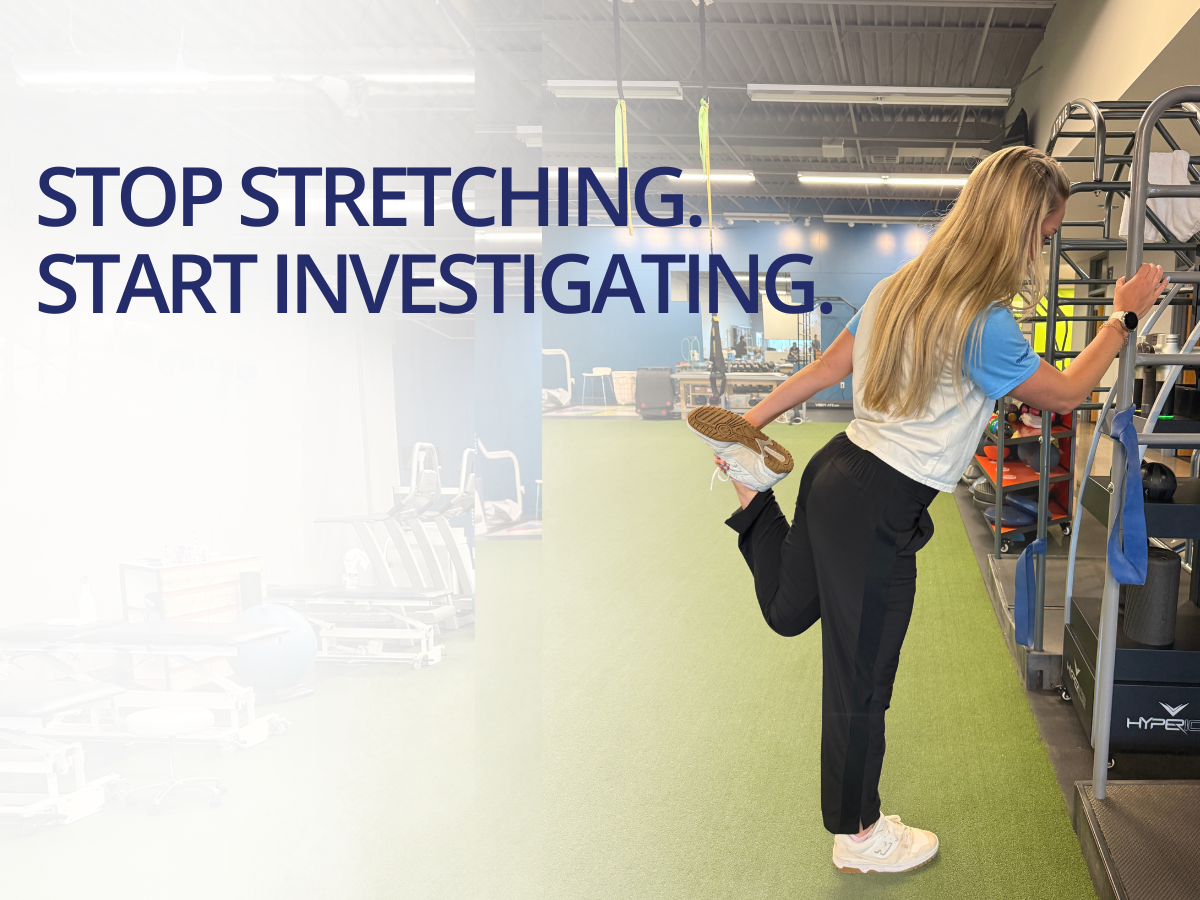
Can a Stiff Joint Make a Nearby Muscle Feel Tight?
Muscles move joints. When a joint is not moving well, nearby muscles often have to change how they work.
A stiff ankle can make the calf feel tight during walking, squatting, or running.
Limited hip motion can increase demand on the hamstrings, groin, or lower back.
A stiff middle back can make the neck and shoulders work harder during reaching, throwing, or swinging a golf club.
This is why stretching only the area that feels tight sometimes misses the source.
Golfers provide a good example. A golfer may repeatedly stretch the shoulder because the backswing feels restricted. The true limitation may be coming from the rib cage, middle back, or hips.
Our guide to golf shoulder mobility drills explains how several body regions work together to create rotation.
Can Trigger Points Make Muscles Feel Tight?
Trigger points are sensitive areas within muscle tissue that may feel tender, knotted, or difficult to relax.
They can create local discomfort, but they may also contribute to symptoms in another area.
A trigger point near the shoulder blade may be felt in the shoulder or arm. One in the neck may contribute to a headache. One in the hip may create discomfort farther down the leg.
People with trigger points often describe a deep tight feeling that stretching cannot quite reach.
This can be part of Myofascial Pain Syndrome, a condition involving pain and sensitivity in muscles and the fascia that surrounds and connects them.
Stretching may still be one part of treatment. Other approaches may include movement changes, strengthening, hands on treatment, or dry needling based on the person and the source of the symptoms.
Can Nerve Irritation Feel Like a Tight Muscle?
It can.
Nerve related symptoms do not always feel like obvious numbness or electrical pain. Some people describe pulling, burning, tension, or a deep tightness that they cannot stretch away.
When Not to Stretch Harder
Tightness accompanied by any of the following symptoms may involve nerve irritation rather than a simple flexibility limitation:
- Numbness or tingling
- Burning or shooting pain
- Weakness
- Pain traveling down an arm or leg
- Symptoms that change with neck or back position
A more aggressive stretch is not automatically better in this situation.
Pulling harder on a sensitive nerve can sometimes increase symptoms. A physical therapist can help determine whether the feeling is coming from a muscle, a joint, a nerve, or a combination of several factors.
Can Stress and Poor Sleep Make Muscles Feel Tighter?
Stress can change breathing, posture, muscle activity, and how the nervous system responds to discomfort.
Think about what happens during a stressful day. The shoulders rise. The jaw tightens. Breathing may become shallow. The body spends more time in one position.
Sleep also matters.
Poor sleep and musculoskeletal pain can influence each other. Pain may interrupt sleep, while poor sleep may make the body more sensitive to pain and less prepared to recover from activity.
This does not mean that stress or sleep is “all in your head.”
It means muscles do not operate separately from the rest of the person.
A complete plan may need to consider movement, strength, workload, stress, sleep, and recovery instead of searching for one perfect stretch.
Does Stretching Ever Help Tight Muscles?
Absolutely.
Stretching can increase range of motion both after a single session and when practiced consistently over time.
It can be useful when:
- A muscle or joint has a true range of motion limitation
- An activity requires more flexibility
- A stretch feels comfortable and improves movement
- You have been still for a long period
- It is one part of a larger exercise plan
The point of this article is not to tell you to stop stretching.
The point is to stop assuming every tight feeling has the same cause.
Stretching May Be the Right Tool
It simply needs to match the problem. A helpful stretch should improve how you move or feel without creating sharper pain, numbness, or increased symptoms.
Why Does My Muscle Tighten Right Back Up?
Temporary relief often means you changed the symptom without changing the demand placed on the area.
Your calf may loosen after stretching, but it still has to absorb the same force during every step.
Your neck may feel better after a massage, but it still has to handle the same work position for the next eight hours.
Your hamstrings may feel longer after a stretch, but your hips and trunk still control movement in the same way.
The tightness returns because the body returns to the same task with the same available options.
Lasting improvement often requires increasing those options.
That may mean:
- Building strength and endurance
- Improving motion in a nearby joint
- Changing how force is absorbed
- Improving balance or movement control
- Reducing unnecessary guarding
- Changing training volume
- Improving recovery habits
What Actually Helps Muscles Stop Feeling Tight?
The answer depends on why the muscle feels tight.
A useful plan may combine several approaches.
Strength Through a Full Range of Motion
Strength training can improve both strength and range of motion when exercises are performed with good control through an appropriate range.
This can help a muscle become more capable instead of simply making it feel looser for a short time.
Movement Variety
The body generally responds better when it has more than one way to complete a task.
Changing positions, walking during the day, reaching in different directions, and using a variety of exercises can reduce repeated stress on the same tissues.
Joint Mobility
If a nearby joint is limited, improving that motion may reduce the demand placed on the tight muscle.
Movement Control
Some people have enough mobility but struggle to control it. Their body responds by creating tension.
Balance exercises, controlled strength work, and task specific movement may help the body feel more confident using the available motion.
Manual Therapy or Dry Needling
Hands on care and dry needling may help reduce pain or sensitivity for some people, particularly when trigger points or myofascial pain are involved.
Research suggests dry needling may provide short term pain relief for some musculoskeletal conditions, although results for long term function are less certain. At TruMove, it is typically combined with movement and exercise rather than treated as the entire plan.
Better Recovery
Sleep, training load, stress, and time between demanding activities can affect how a muscle feels and performs.
Sometimes the best mobility decision is not another intense stretch. It is giving the body enough recovery to adapt.
What Do We Commonly See at TruMove?
The tight muscle is often the loudest part of the problem, but it is not always the most important part.
We see runners who stretch their calves every day even though the bigger issue is how they absorb force through the ankle and hip.
We see office workers who pull on their neck for relief when the muscles really need more endurance, movement variety, and a better way to manage the workday.
We see golfers who keep stretching the shoulder when their middle back and hips are limiting rotation.
We see active adults who believe they are losing flexibility with age when the bigger change is that they have stopped strength training through their full available motion.
This is why TruMove’s approach starts with a movement evaluation rather than a list of generic stretches.
Our physical therapists look at:
- Where you feel tightness
- How much motion you actually have
- How well you control that motion
- Strength and endurance
- Joint mobility
- Nerve related symptoms
- Your daily activities and exercise habits
The goal is to determine what the tight feeling is trying to tell us.
When Should I See a Physical Therapist for Tight Muscles?
Occasional tightness after exercise, travel, or a long day is common.
An evaluation may be useful when:
- The same tightness keeps returning
- Stretching only helps for a few minutes
- The tightness limits exercise or daily activity
- You also have pain, numbness, tingling, or weakness
- The area feels less stable or less powerful
- Your range of motion is getting worse
- You are unsure whether stretching is safe
You do not need to wait until the feeling becomes severe.
A movement based physical therapy evaluation can help identify whether you need more flexibility, more strength, better joint motion, improved control, or a different approach entirely.
Learn more about physical therapy in Overland Park at TruMove.
Frequently Asked Questions About Tight Muscles and Stretching
Why are my hamstrings always tight?
Hamstrings may feel tight because of limited flexibility, but they may also be overworked, weak, guarding a painful area, or compensating for the hips and trunk. Testing movement and strength can help identify the most likely cause.
Can a weak muscle feel tight?
Yes. A muscle that lacks strength or endurance may work harder during daily activities and begin to feel tense, tired, or tight.
How long should I hold a stretch?
The best duration depends on the goal, the muscle, and the individual. A gentle stretch held for about 15 to 30 seconds is commonly used, but longer or repeated stretches may be appropriate in some programs. A stretch should not cause sharp pain, numbness, or tingling.
Should I stretch every day?
Daily stretching can be helpful when you are working on a true flexibility limitation and the stretching is comfortable. It may not be necessary for every muscle, and it should not replace strength, movement, and recovery.
Why does massage or foam rolling only help temporarily?
Massage and foam rolling may reduce discomfort or change the sensation of tightness. The feeling may return when the same weakness, joint restriction, workload, or movement pattern is still present.
Is stretching bad for tight muscles?
No. Stretching is not bad. It is simply one tool. It works best when the muscle actually benefits from more range and when it is paired with the strength and control needed to use that range.
Can dry needling help a tight muscle?
Dry needling may help reduce pain and sensitivity related to trigger points or myofascial pain in some people. It should be performed by a properly trained clinician and used as part of an individualized treatment plan.
Stop Chasing the Tightness and Start Looking for the Reason
Stretching can be useful. It can improve flexibility, feel good, and prepare the body to move.
But a muscle that keeps tightening may not need to be stretched harder.
It may need more strength. It may need help from another joint. It may be protecting an irritated area. It may be tired, sensitive, or taking on more work than it can manage.
Understanding the reason is what turns temporary relief into a better plan.
The Better Question
Instead of asking, “What stretch should I do?” start by asking, “Why does this muscle keep feeling tight?”
Sources
- Strength Training Versus Stretching for Improving Range of Motion: A Systematic Review and Meta Analysis
- Resistance Training Induces Improvements in Range of Motion: A Systematic Review and Meta Analysis
- Practical Recommendations on Stretching Exercise
- Feeling Stiffness in the Back: A Protective Perceptual Inference
- Clinical Effectiveness of Dry Needling in Patients With Musculoskeletal Pain
- The Relationship Between Sleep Problems and Chronic Musculoskeletal Pain
The content provided in this blog post is for educational purposes only and reflects the expertise and clinical experience of TruMove Physical Therapy staff. It is not intended as a substitute for medical diagnosis or treatment. Always consult a qualified healthcare provider if you have persistent pain, weakness, numbness, tingling, a recent injury, or concerns about beginning a new exercise or treatment plan.


